

Hair extension terminology explained: a complete guide
Hair extension jargon can stop even experienced stylists mid-sentence. Terms like “double-drawn,” “cuticle-aligned,” “weft,” and “micro-link” get tossed around in consultations and product listings without much explanation, leaving clients guessing and professionals second-guessing. Whether you’re sitting in a salon chair for the first time or you’ve been installing extensions for years, a solid grip on the vocabulary changes everything. This guide breaks down every key term clearly, so you can shop smarter, consult more confidently, and get results that actually match your vision.
Table of Contents
- Why terminology matters in hair extensions
- Foundational hair extension terms you need to know
- Types of hair extension methods: explained
- Understanding hair extension lifespan and maintenance
- Practical tips for clear communication and best results
- Explore premium hair extensions and expert support
- Frequently asked questions
Key Takeaways
| Point | Details |
|---|---|
| Terminology builds confidence | Knowing extension terms enables smoother consultations and more informed buying decisions. |
| Method matters for results | Each installation technique—tape-in, sew-in, clip-in—has its own ideal use and maintenance needs. |
| Quality extends lifespan | Understanding grades, origin, and care terms helps select extensions that look better, longer. |
| Clear communication is key | Precise language and documentation prevent costly mistakes and lead to happier results for all. |
Why terminology matters in hair extensions
Precise language is the foundation of every successful hair extension experience. When a client says she wants “voluminous, natural-looking hair” and a stylist hears “thick bundles with a loose wave,” the result depends entirely on whether both people are speaking the same language. Misunderstandings at the consultation stage are one of the leading causes of costly corrections and damaged hair.
Terminology in this industry covers a wide range of categories:
- Hair origin: Where the hair comes from (Indian, Brazilian, European)
- Processing level: Whether the hair is raw, virgin, or chemically treated
- Structure: How the hair is constructed (weft, strand, bundle)
- Installation method: How the hair is applied (tape-in, sew-in, fusion)
- Quality indicators: Terms like Remy, cuticle-aligned, and single donor
A clear grasp of terminology empowers better selection and longer-lasting results. For both clients and stylists, knowing the right words means fewer surprises, less wasted money, and a much smoother process from start to finish. If you’re still figuring out where to begin, reading up on choosing the right hair extensions is a strong first step.
Pro Tip: Before any consultation, write down three to five words that describe your hair goal. Bring photos. This gives your stylist a concrete starting point and reduces the chance of a terminology mismatch.
Foundational hair extension terms you need to know
Let’s start with the building blocks. These are the terms you’ll encounter in almost every product listing, salon menu, or online review.
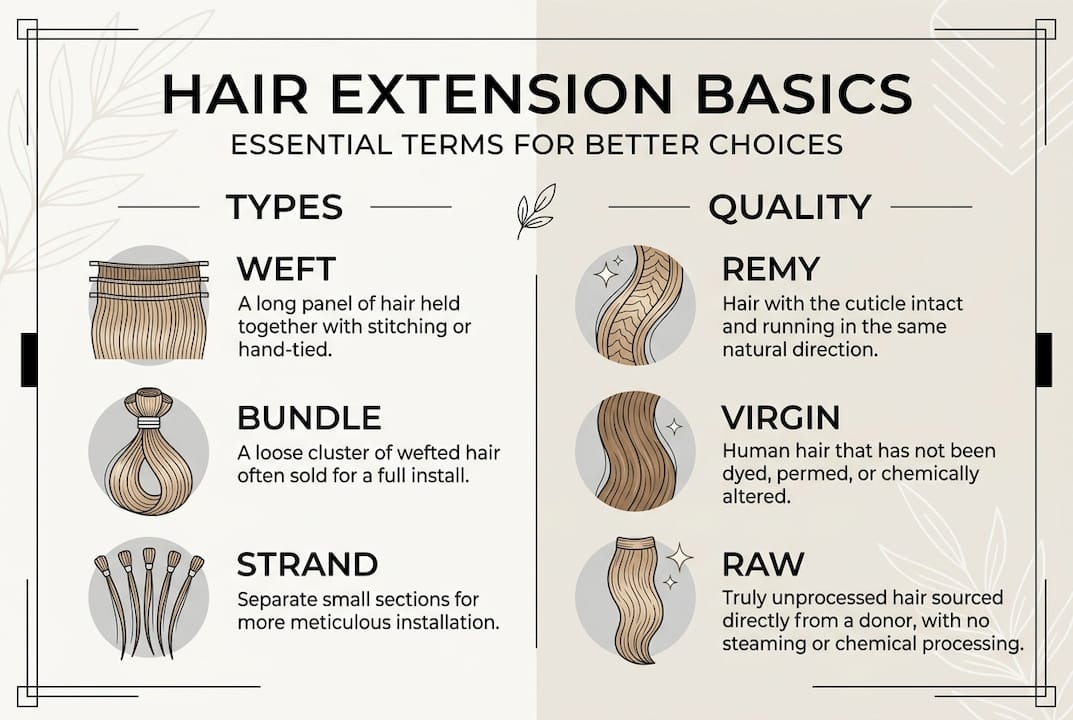
Weft: A strip of hair that has been sewn or bonded together along a track. Wefts can be machine-made or hand-tied, and the difference matters. Hand-tied wefts are thinner and more flexible, making them ideal for fine hair.
Bundle: A packaged quantity of wefts, typically sold by weight (usually 100g). Most full installs require two to four bundles depending on the desired volume and length.
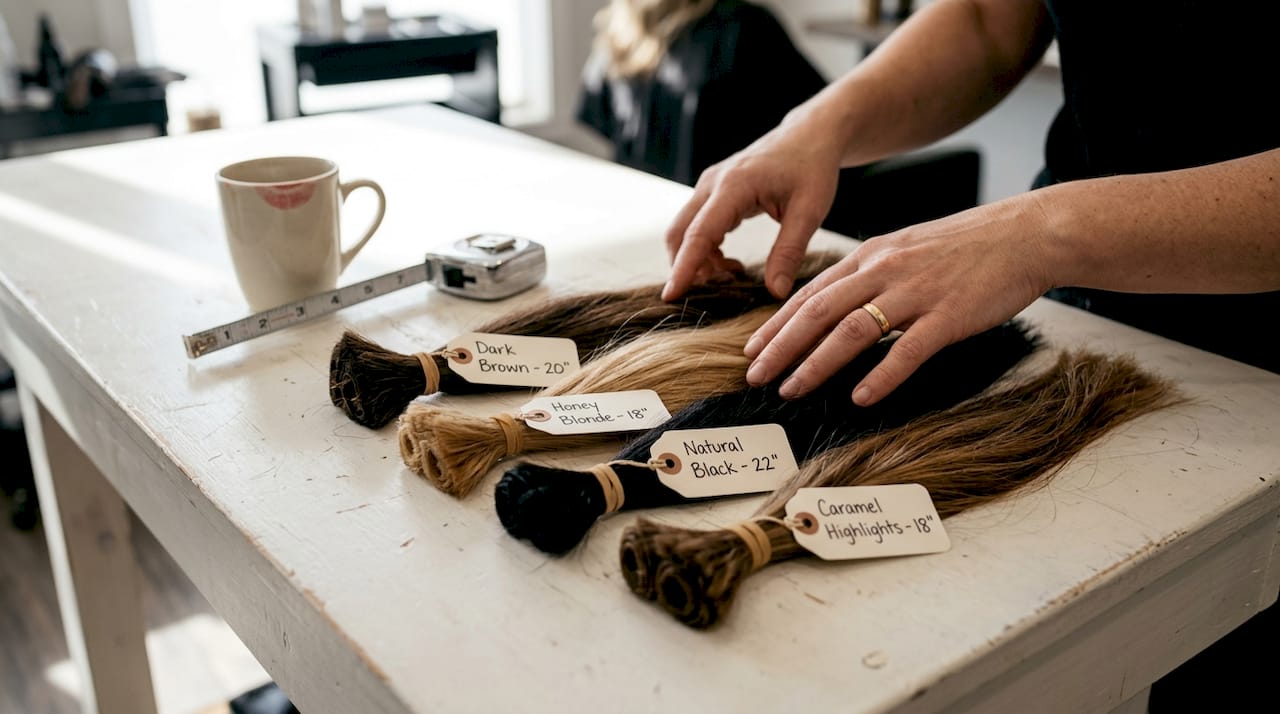
Strand: An individual section of hair, typically used in fusion or micro-link methods where hair is applied piece by piece rather than in strips.
Remy hair: Hair where all cuticles run in the same direction from root to tip. This prevents tangling and matting, which is why Remy is considered a quality standard. Non-Remy hair has cuticles stripped with acid, which causes faster deterioration.
Virgin hair: Hair that has never been chemically processed, coloured, permed, or relaxed. It retains its natural strength and can be coloured or styled just like your own hair.
Raw hair: A step above virgin. Raw hair is completely unprocessed and comes from a single donor, meaning it hasn’t been sorted, mixed, or steam-processed. It’s the most natural and durable option available.
Cuticle-aligned hair: Hair where the cuticle layer runs uniformly from root to tip across all strands. This is what separates premium extensions from budget options that tangle within weeks.
Here’s a quick comparison of hair types by quality level:
| Hair type | Processing | Cuticle intact | Longevity | Best for |
|---|---|---|---|---|
| Synthetic | Fully artificial | No | 1-3 months | Temporary styles |
| Human (non-Remy) | Stripped cuticle | No | 3-6 months | Budget installs |
| Remy human | Minimal | Yes | 6-12 months | Regular wear |
| Virgin human | None | Yes | 12-18 months | Long-term use |
| Raw human | None (single donor) | Yes | 18+ months | Premium installs |
Understanding key data on install methods and quality tiers helps you match the right product to the right client. If you’re weighing your options, comparing a hair bundle vs. clip-in extensions is a great way to understand how construction affects performance. You can also explore the full range of types of hair extensions to see how these terms apply across different styles.
Types of hair extension methods: explained
Knowing what hair to buy is only half the equation. How it’s installed determines comfort, longevity, and suitability for your hair type. Here’s a breakdown of the most common methods.
1. Tape-in extensions Pre-taped wefts are sandwiched around sections of natural hair. They’re semi-permanent and require professional installation. Tape-in extensions last 6-8 weeks before needing a move-up (repositioning as hair grows). They’re flat, lightweight, and virtually undetectable.
2. Sew-in or weave Natural hair is braided into cornrows, and wefts are sewn directly onto those braids. This method is protective and long-lasting, typically 6-10 weeks. It’s best suited for thicker hair types that can handle the tension of braiding.
3. Clip-in extensions Temporary wefts with small pressure clips attached. They can be applied and removed at home in minutes, making them the most beginner-friendly option. No professional installation needed, and no commitment required.
4. Fusion (keratin bond) Individual strands are bonded to natural hair using a keratin adhesive and a heat tool. This method gives the most natural look and movement but takes the longest to install. It’s also the most expensive and requires professional removal.
5. Micro-link (micro-bead) Small metal rings (beads) are used to attach individual strands to sections of natural hair without heat or adhesive. They’re adjustable and reusable, making them a popular choice for clients who want a long-term, low-chemical option.
6. Wig units Full wigs or lace units that sit over the entire head. They can be glued, clipped, or sewn down. Lace front and full-lace wigs offer the most natural hairline appearance.
Here’s a side-by-side comparison to help you decide:
| Method | Duration | DIY-friendly | Best hair type | Cost level |
|---|---|---|---|---|
| Tape-in | 6-8 weeks | No | Fine to medium | Moderate |
| Sew-in | 6-10 weeks | No | Thick, coarse | Moderate |
| Clip-in | Daily removal | Yes | All types | Low |
| Fusion | 3-6 months | No | Medium to thick | High |
| Micro-link | 3-6 months | No | Medium to thick | High |
| Wig unit | Varies | Yes | All types | Varies |
For a deeper look at how these methods are used in professional settings, explore hair extension methods in salons. If clip-ins are your focus, the clip-in extensions guide covers blending techniques in detail. And if you’re thinking long-term, understanding hair extension longevity will help you set realistic expectations.
Pro Tip: Always match the installation method to the client’s lifestyle, not just their hair type. A client who swims daily needs a different method than one who rarely washes her hair.
Understanding hair extension lifespan and maintenance
Terminology doesn’t stop at the install. Words like removal, move-up, and reinstallation are part of the ongoing care cycle that determines how long your extensions actually last.
Move-up: When tape-in or micro-link extensions are repositioned closer to the scalp as natural hair grows. This is not a full removal; it’s a maintenance appointment.
Reinstallation: After full removal, the hair is cleaned, inspected, and reapplied. High-quality raw or virgin hair can often be reinstalled multiple times.
Removal: The process of safely detaching extensions from natural hair. Improper removal is one of the most common causes of breakage and damage.
Key factors that affect how long your extensions last:
- Hair quality: Raw and virgin hair consistently outlasts processed options
- Installation method: Fusion and micro-link methods typically last 3-6 months; tape-ins and sew-ins have specific 6-8 and 6-10 week timelines respectively
- Care routine: Sulphate-free shampoo, minimal heat, and proper detangling extend wear significantly
- Sleeping habits: Using a silk or satin pillowcase reduces friction and tangling overnight
- Product build-up: Silicone-based products near the bonds or tape can cause slippage
For a full breakdown of what keeps extensions in top condition, the hair extension care tips guide is worth bookmarking. You can also read more about hair extension durability to understand what separates a three-month install from an eighteen-month one. For tools that support your maintenance routine, beauty maintenance tools can help round out your kit.
Practical tips for clear communication and best results
Understanding the terms is one thing. Using them effectively in a consultation or purchase decision is where the real value shows up.
Here’s a checklist to bring to your next consultation:
- Hair history: Have you coloured, relaxed, or heat-styled your hair recently? This affects which extension type is safe to use.
- Goal: Are you adding length, volume, or both? Do you want a temporary or semi-permanent result?
- Method preference: Do you have experience with a specific install method? Any sensitivities to adhesives or heat?
- Budget: Know your range for both the hair and the installation. Quality raw hair costs more upfront but saves money over time.
- Maintenance commitment: How much time can you realistically dedicate to upkeep each week?
Some terms that often cause confusion during consultations:
- Rooted: Extensions with a darker shade at the root to mimic natural regrowth. This creates a more blended, low-maintenance look.
- Double-drawn: Hair where shorter strands have been removed, leaving a consistent thickness from root to tip. This gives maximum volume.
- Single donor: All hair in the bundle comes from one person, ensuring consistent texture and colour throughout.
“The best extension results come from clear, documented consultations where both the stylist and client agree on terminology, method, and expectations before a single strand is applied.”
Keeping before-and-after photos and written records of each install helps both stylists and clients track what works. It also makes avoiding common pitfalls in consultation much easier when you have a reference point. If you’re still deciding between hair types, comparing natural vs synthetic extensions will clarify which direction suits your goals best.
Explore premium hair extensions and expert support
Now that your terminology toolkit is full, the next logical step is finding extensions that actually live up to the standards you’ve just learned about. At Gaurash Hair, every product is sourced from 100% raw and virgin Indian hair, meaning cuticle-aligned, single-donor quality you can see and feel.
Whether you’re a stylist building your salon inventory or a client ready to invest in a long-lasting install, we carry options for every method and texture. Explore our premium Indian straight extensions for a sleek, natural finish, or browse our fusion hair extensions for a seamless, long-term result. Our full extension catalogue covers bundles, wigs, closures, frontals, and tape-ins, all backed by fast global shipping and expert support.
Frequently asked questions
What does ‘Remy’ mean when buying hair extensions?
Remy hair means the cuticle is kept intact and aligned from root to tip, which produces smoother, tangle-resistant extensions that last significantly longer than non-Remy alternatives. It’s one of the most important quality indicators to look for when comparing products.
How long do tape-in extensions last?
Tape-in extensions typically last 6-8 weeks before needing a move-up or reinstallation, depending on how quickly your natural hair grows and how well you maintain them.
What is the difference between a ‘weft’ and a ‘bundle’?
A weft is the actual strip of hair that has been sewn or bonded together, while a bundle is the packaged quantity of wefts sold by weight, usually 100g, for a full or partial install.
Are sew-in extensions suitable for fine hair?
Sew-ins are generally better suited to thicker hair types, as the braiding required for installation can place too much tension on fine strands, potentially causing breakage or traction alopecia over time. A tension-prone technique like this needs the right hair foundation.
What are common mistakes to avoid when choosing extensions?
The most frequent errors include mismatching hair texture to your natural hair, underestimating maintenance requirements, and misunderstanding key terms during the consultation stage, all of which lead to poor results and unnecessary expense.
Recommended
- What is hair extension durability? A 2026 expert guide – Gaurash Beauty Supply
- Hair bundles versus clip-ins: best extensions 2026 – Gaurash Beauty Supply
- Hair extension selection guide 2026: choose premium Indian hair – Gaurash Beauty Supply
- Role of hair extensions in salons: benefits 2026 – Gaurash Beauty Supply