

How to identify quality hair: 93% seek authentic extensions
Finding authentic, high-quality hair extensions can feel overwhelming when so many products claim perfection. Whether you’re a consumer seeking luxury enhancements or a professional stylist building client trust, knowing how to verify quality is essential. This guide walks you through practical tests, expert-verified methods, and forensic insights to help you confidently identify genuine virgin hair. You’ll learn what works, what doesn’t, and how to avoid costly mistakes when investing in premium extensions.
Table of Contents
- Key takeaways
- Understanding the problem of quality identification
- Preparing to test and identify quality hair
- Step-by-step guide to practical hair quality tests
- Verifying authenticity and avoiding common pitfalls
- Discover premium hair extensions with Gaurash Beauty Supply
- How to identify quality hair: frequently asked questions
Key Takeaways
| Point | Details |
|---|---|
| Surface tests limited | Simple checks such as texture shine or smell can indicate surface quality but cannot conclusively verify origin or processing without laboratory analysis. |
| Advanced verification needed | Microscopic cuticle examination and mitochondrial DNA analysis can identify donor origin and processing history beyond what practical tests show. |
| Sound sampling practice | Take samples from the weft interior rather than the exterior to obtain a representative assessment of the bundle quality. |
| Forensic limits acknowledged | The guide emphasises limitations of testing and helps buyers balance practical tips with expert recommendations for informed decisions. |
Understanding the problem of quality identification
Identifying truly high-quality hair extensions presents challenges that go far beyond what meets the eye. Many consumers and stylists rely on surface-level assessments like texture, shine, or smell, but these methods tell an incomplete story. The reality is that industry-standard tests cannot conclusively verify hair origin or processing history, leaving buyers vulnerable to misleading claims.
The hair extension market thrives on terminology like virgin, raw, and Remy, yet these labels lack standardised verification. A bundle labelled as virgin Indian hair might actually contain chemically treated fibres or hair from multiple sources. Without access to forensic analysis, you’re left trusting vendor honesty and your own limited testing capabilities. This knowledge gap creates uncertainty that affects both personal purchases and professional salon investments.
Several factors complicate quality assessment:
- Surface treatments can temporarily mask poor-quality hair with silicone coatings
- Mixed-origin hair bundles may contain strands from different donors
- Chemical processing history remains invisible without laboratory testing
- Cuticle removal or reversal techniques create deceptive smoothness
Authentic quality verification requires scientific methods like microscopic cuticle examination and mitochondrial DNA analysis. These forensic approaches reveal processing history, donor origin, and structural integrity that simple salon tests cannot detect. However, most consumers and even professional stylists lack access to such advanced verification tools.
“The hair industry’s reliance on superficial quality tests creates a forensic science problem where buyers cannot truly verify what they’re purchasing without laboratory-grade analysis.”
Understanding these limitations helps you approach hair extension purchases with realistic expectations. While practical tests provide useful indicators, they represent just the starting point of quality assessment. For comprehensive guidance on making informed choices, explore our hair extension buying guide essential steps to build a complete evaluation framework.
Preparing to test and identify quality hair
Before conducting any quality tests, proper preparation ensures accurate results and protects your investment. Gather essential materials including bright natural lighting, a magnifying glass or jeweller’s loupe, small sharp scissors, a clean bowl of water, and a lighter if you plan burn testing. Good lighting is crucial because subtle cuticle patterns and colour variations only appear under proper illumination.
Create a clean, flat workspace where you can examine hair strands without contamination. Remove a small sample from the weft interior rather than the exterior, as vendors sometimes place higher-quality hair on visible surfaces. This sampling approach gives you a more honest assessment of the entire bundle’s quality.

| Test type | What it reveals | Limitations |
|---|---|---|
| Slip/cuticle test | Cuticle alignment and direction | Cannot verify origin or chemical history |
| Burn test | Synthetic vs human hair | Cannot distinguish quality grades or processing |
| Float test | Hair density and porosity | Results vary with treatments and moisture |
| Bleach test | Chemical resistance | Requires product damage and time |
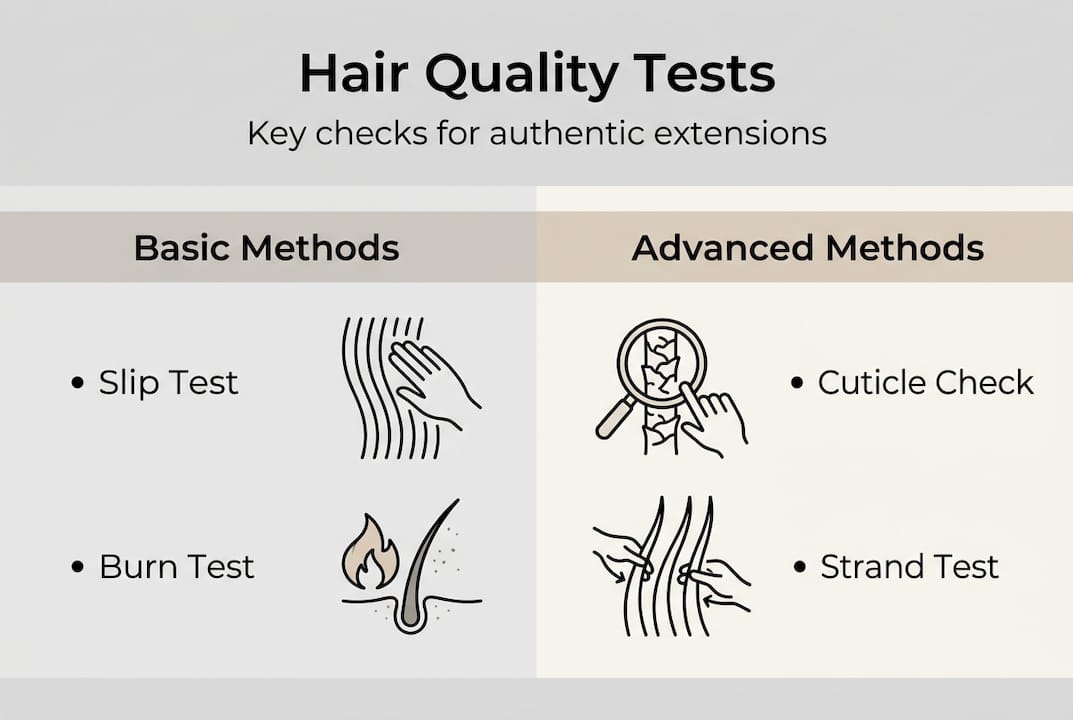
The slip/cuticle test indicates hair surface condition and cuticle alignment, making it one of the most practical methods for initial quality assessment. This test involves running your fingers along the hair shaft from root to tip, then reversing direction. Quality virgin hair with intact cuticles feels smooth downward but creates slight resistance upward.
Each testing method provides specific insights:
- Slip/cuticle test assesses cuticle integrity and alignment direction
- Burn test distinguishes human hair from synthetic fibres through smell and ash
- Float test evaluates density, though treated hair may sink despite being lower quality
- Bleach test shows chemical resistance but requires damaging a portion of the product
Pro Tip: Always test a small strand first, ideally before purchasing or immediately upon delivery while return options remain available. This approach protects your investment and provides leverage if quality doesn’t match vendor claims.
Understanding what defines authentic virgin hair helps contextualise your test results. Review virgin hair standards to recognise the characteristics you should expect from premium products. This knowledge transforms testing from guesswork into informed quality verification.
Step-by-step guide to practical hair quality tests
Performing quality tests systematically reveals important characteristics about your hair extensions. Follow these steps carefully, interpreting results within the context of each test’s limitations.
-
Perform the slip/cuticle test first. Hold a small section of hair at the root end and run your fingers downward toward the tips. The slip/cuticle test involves running fingers root-to-tip to feel smooth with light resistance, indicating intact cuticles. Now reverse direction, moving from tips to roots. Quality virgin hair creates noticeable friction when moving against the cuticle direction. If the hair feels equally smooth in both directions, cuticles may be removed or chemically altered.
-
Conduct the burn test for basic fibre identification. Remove a few strands and hold them with tweezers over a non-flammable surface. Light the ends with a flame and observe carefully. Human hair burns slowly, smells like burnt protein or feathers, and creates ash that crumbles easily. Synthetic fibres melt into hard beads, smell like burning plastic, and often produce black smoke. This test only confirms human versus synthetic content, not quality grade or origin.
-
Use the float test to assess density. Fill a clear glass with room-temperature water and drop a small, clean hair sample into it. Quality virgin hair typically sinks within seconds due to its natural density and lack of coating. However, this test has limitations because chemically treated hair can also sink if coatings have been removed, and some authentic hair floats temporarily due to trapped air. Wait at least 30 seconds before drawing conclusions.
-
Try the bleach test if you can spare a sample. Mix a small amount of hair lightener or bleach according to package directions. Apply it to a test strand and observe the reaction over 20 to 30 minutes. Quality virgin hair lightens gradually and evenly, maintaining structural integrity. Over-processed or synthetic-blend hair may dissolve, break apart, or lighten unevenly with visible damage. This test requires product sacrifice and time but reveals chemical resistance.
-
Examine cuticle direction under magnification. Use a magnifying glass or smartphone macro lens to inspect the hair shaft closely. Look for a scale-like pattern running in one consistent direction. Cuticles pointing the same way indicate single-donor, properly aligned hair. Mixed directions or absent cuticles suggest lower quality or processing.
-
Assess overall appearance and texture. Quality hair maintains natural variation in thickness and subtle colour differences along the shaft. Perfectly uniform colour and diameter often indicate chemical processing or coating. Run your hands through the hair and note whether it tangles easily, which can signal cuticle removal or reversal.
Pro Tip: Combine at least three different tests for the most reliable quality indication. No single test provides complete verification, but patterns across multiple assessments reveal likely quality levels. When uncertain, consult a professional stylist experienced with premium extensions.
For broader context on selecting extensions that meet your needs, review guidance on choosing hair extensions naturally. This resource helps you balance quality testing with practical considerations like texture matching and maintenance requirements.
Verifying authenticity and avoiding common pitfalls
While practical tests provide useful indicators, true authenticity verification requires more sophisticated analysis. Expert nuance shows forensic methods like medullary index and mtDNA analysis are required to identify donor origin and processing history. These laboratory techniques examine hair at microscopic and genetic levels, revealing information invisible to standard testing.
Forensic verification methods include:
- Microscopic cuticle scale pattern analysis to confirm human hair and assess processing
- Medullary index measurement to distinguish ethnic origin and donor authenticity
- Mitochondrial DNA sequencing to verify single-donor claims and geographic source
- Chemical residue testing to detect processing treatments and coating applications
These advanced methods remain largely inaccessible to everyday consumers due to cost and specialised equipment requirements. However, understanding their existence helps you recognise the limitations of home testing and adjust your purchasing strategy accordingly. Reputable vendors who invest in laboratory verification can provide documentation supporting their quality claims.
Common mistakes undermine even careful quality assessment. Many buyers place excessive trust in the burn test, assuming it confirms quality when it only distinguishes human from synthetic fibres. Others ignore cuticle direction entirely, missing a critical indicator of processing and alignment. Relying on vendor descriptions without independent verification leads to disappointment when products arrive.
| Test method | Strength | Weakness |
|---|---|---|
| Slip/cuticle | Easy to perform, indicates cuticle presence | Cannot verify origin or detect all processing |
| Burn | Confirms human vs synthetic | Reveals nothing about quality grade or source |
| Float | Quick density assessment | Affected by treatments and moisture content |
| Microscopy | Reveals cuticle structure and damage | Requires specialised equipment and expertise |
| mtDNA analysis | Confirms donor origin and authenticity | Expensive and inaccessible for most buyers |
Another frequent error involves purchasing based solely on price. Authentic virgin hair requires significant sourcing and processing investment. Prices far below market averages almost always indicate compromised quality, mixed-origin bundles, or misleading labelling. Conversely, high prices don’t guarantee quality without verification, as some vendors exploit information gaps to overcharge for mediocre products.
Trusting unverified online reviews creates additional risk. Many testimonials come from incentivised buyers or represent isolated positive experiences that don’t reflect consistent quality. Look for detailed reviews mentioning specific tests performed and long-term wear results rather than initial impressions.
“Quality verification in the hair industry demands forensic science standards that most buyers cannot access, creating an authenticity gap that favours misleading marketing over transparent quality assurance.”
Protect yourself by combining practical testing with vendor transparency. Request detailed information about hair sourcing, processing methods, and any laboratory testing performed. Reputable suppliers willingly share this information and often provide samples for testing before large purchases. Compare your findings with established standards by reviewing natural vs synthetic hair extensions to understand quality benchmarks.
When possible, seek professional consultation from experienced stylists who work regularly with premium extensions. Their hands-on expertise with various products provides practical insight that complements your testing efforts. Building relationships with trusted professionals creates a knowledge network that protects against low-quality purchases.
Discover premium hair extensions with Gaurash Beauty Supply
After learning how to identify quality hair, finding a trusted source becomes your next priority. Gaurash Beauty Supply specialises in authentic virgin and raw human hair extensions sourced directly from India, offering the luxury and authenticity you’ve learned to recognise.
Our curated collections undergo careful quality verification to ensure you receive genuine, unprocessed hair that meets professional standards. From virgin hair bundles with intact cuticles to luxurious options like our chocolate brown wig, each product reflects our commitment to authenticity. For those seeking premium blonde options, explore our hd lace front blonde wig raw human hair that combines natural appearance with adjustable comfort. Every piece is selected to deliver the quality indicators you now know to look for, backed by transparent sourcing and responsive customer support.
How to identify quality hair: frequently asked questions
Can I identify hair quality just by looking?
Visual inspection alone cannot confirm quality or authenticity. While you can assess obvious factors like shine, colour consistency, and general appearance, critical indicators like cuticle integrity, processing history, and donor origin require hands-on testing or laboratory analysis. Always combine visual assessment with practical tests like the slip/cuticle method for more reliable evaluation.
What symptoms indicate synthetic instead of natural hair?
Synthetic hair exhibits several telltale signs including unnatural shine that looks plasticky rather than lustrous, perfectly uniform colour without natural variation, and unusual texture that feels either too silky or artificially coarse. The burn test provides definitive confirmation, as synthetic fibres melt into hard beads and smell like burning plastic rather than the protein smell of human hair.
Is the burn test reliable for identifying quality hair?
The burn test reliably distinguishes human hair from synthetic fibres but reveals nothing about quality grade, processing history, or origin. Human hair that has been heavily chemically treated will still burn like human hair and produce the characteristic protein smell. Use the burn test only as a first step to confirm human hair content, then apply additional tests to assess actual quality.
How often do professional verifications of hair authenticity occur?
Professional laboratory verification remains rare in the hair extension industry due to cost and accessibility barriers. Most vendors rely on supplier claims rather than independent testing. Premium brands occasionally invest in forensic analysis for quality assurance, but this represents a small fraction of the market. Consumers typically depend on practical tests and vendor reputation rather than scientific verification.
What should I avoid when buying hair extensions to ensure quality?
Avoid vendors who refuse to provide sourcing information, processing details, or product samples. Steer clear of prices significantly below market averages, as authentic virgin hair requires substantial investment to source and process properly. Don’t rely solely on burn tests or visual inspection for quality confirmation. Skip purchases based only on generic online reviews without detailed quality assessments or long-term wear reports.
Recommended
- How to Choose Hair Extensions for a Natural, Lasting Look – Gaurash Beauty Supply
- Why Prefer Real Hair Extensions for Lasting Beauty – Gaurash Beauty Supply
- Natural vs synthetic hair: choosing the best extensions – Gaurash Beauty Supply
- 6 Essential Steps for a Smart Hair Extension Buying Guide – Gaurash Beauty Supply