

Why choose raw hair over processed hair for best results
You’ve probably scrolled through endless hair extension options, wondering why prices and quality vary so dramatically. The truth is, most buyers don’t realise that the fundamental difference between raw and processed hair determines everything from how your extensions hold a curl to how many years they’ll last. Raw hair retains its natural structure and cuticle integrity, giving you unmatched styling versatility and durability. This guide breaks down exactly why raw hair stands out as the superior choice for anyone seeking extensions that look natural, style beautifully, and deliver lasting value.
Table of Contents
- Key takeaways
- What is raw hair: quality and purity defined
- How processing alters hair structure and reduces quality
- Styling versatility and durability: raw hair advantages
- How to choose and care for raw hair extensions
- Explore premium raw hair extensions at Gaurash Beauty Supply
- Frequently asked questions
Key Takeaways
| Point | Details |
|---|---|
| Cuticle integrity preserved | Raw hair remains with intact cuticles, which reduces damage and frizz risk. |
| Low porosity resists damage | Its low porosity means it absorbs less water and chemicals, protecting the internal structure and helping it stay stronger through styling. |
| Single donor sourcing | Raw hair comes from a single donor and undergoes zero chemical processing, preserving natural texture and consistency. |
| Processed hair drawbacks | Chemical processing lifts or removes cuticles and weakens protein bonds, making strands porous and prone to frizz, damage, and quicker deterioration. |
What is raw hair: quality and purity defined
Raw hair comes from a single donor and undergoes zero chemical processing from collection to sale. This preservation matters because the hair’s cuticle layer, the outermost protective sheath of each strand, remains completely intact and aligned in one direction. Think of cuticles like roof shingles: when they lie flat and point the same way, water and damage slide off harmlessly.
This structural integrity creates mechanically superior hair with lower porosity. Lower porosity means the hair absorbs less water and fewer chemicals, protecting the internal protein structure from degradation. Your extensions stay stronger, shinier, and more resilient through repeated styling.
Processed hair tells a different story entirely. Manufacturers subject these fibres to bleaching, acid washes, and harsh dyes to achieve uniform colour and texture across batches from multiple donors. These treatments strip natural oils, lift or remove cuticles entirely, and compromise the hair’s protein bonds. The result is porous, brittle strands that tangle easily and break under normal styling stress.
When cuticles are damaged or removed, the hair’s internal structure becomes exposed. Friction during brushing, styling, and even sleeping causes the exposed cortex to shed protein molecules. This protein loss weakens the fibre progressively, explaining why processed extensions deteriorate so rapidly compared to their raw counterparts.
Key attributes of raw hair quality:
- Cuticles remain intact and aligned unidirectionally, minimising friction damage
- Low porosity structure resists excessive water and chemical absorption
- Natural oils and proteins stay sealed within the hair shaft
- Single donor sourcing ensures consistent texture and behaviour
- Zero chemical treatments preserve mechanical strength and elasticity
- Natural colour variation reflects authentic, unaltered hair characteristics
Pro Tip: Run your fingers down a strand of genuine raw hair in both directions. It should feel smooth going down but slightly rough going up, confirming intact, aligned cuticles.
The physical difference between raw and processed hair becomes obvious under magnification. Raw hair shows smooth, overlapping cuticle scales like a healthy pinecone. Processed hair reveals lifted, damaged, or entirely missing scales, exposing the vulnerable cortex beneath. This microscopic difference translates directly to how your extensions perform during heat styling, colouring, and daily wear.
How processing alters hair structure and reduces quality
Chemical processing fundamentally changes hair at the molecular level, and understanding these changes helps you make informed purchasing decisions. Manufacturers use bleaching agents, typically hydrogen peroxide, to strip natural melanin pigment from hair shafts. This oxidation process doesn’t just remove colour; it breaks down protein bonds within the cortex, permanently weakening the fibre.
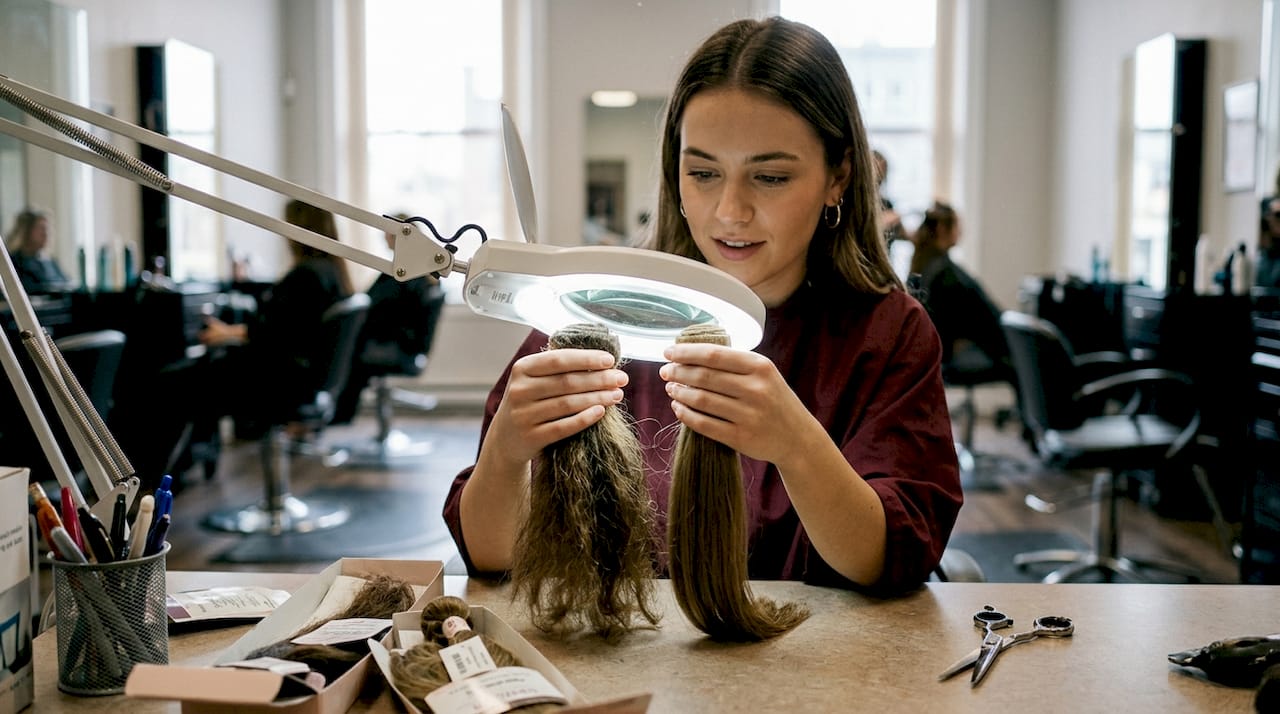
Acid washes follow bleaching to remove the damaged cuticle layer entirely. While this creates a temporarily smooth appearance, it leaves the cortex completely exposed to environmental damage, moisture loss, and mechanical stress. Think of it like removing the protective bark from a tree: the wood beneath becomes vulnerable to every external threat.
Harsh synthetic dyes then coat the exposed cortex to achieve uniform colour across batches. These dyes don’t penetrate naturally because the cuticle barrier no longer exists. Instead, they sit on the surface, fading quickly and creating an artificial, flat appearance that lacks the dimensional colour of natural hair.
| Property | Raw hair | Processed hair |
|---|---|---|
| Porosity level | 15-20% water absorption | 35-50% water absorption |
| Tensile strength | 150-200 MPa | 80-120 MPa |
| Heat tolerance | Up to 180°C safely | Maximum 150°C before damage |
| Cuticle condition | Intact, aligned scales | Damaged, lifted, or removed scales |
| Chemical responsiveness | Predictable, even results | Uneven absorption, unpredictable outcomes |
| Protein retention | High, stable over time | Rapid loss through exposed cortex |
The increased porosity in processed hair creates a cascade of problems. High porosity means the hair absorbs moisture rapidly but also loses it just as quickly, leading to constant dryness and frizz. When you apply heat or chemicals, the porous structure absorbs them unevenly, resulting in patchy colour or heat damage concentrated in weaker areas.
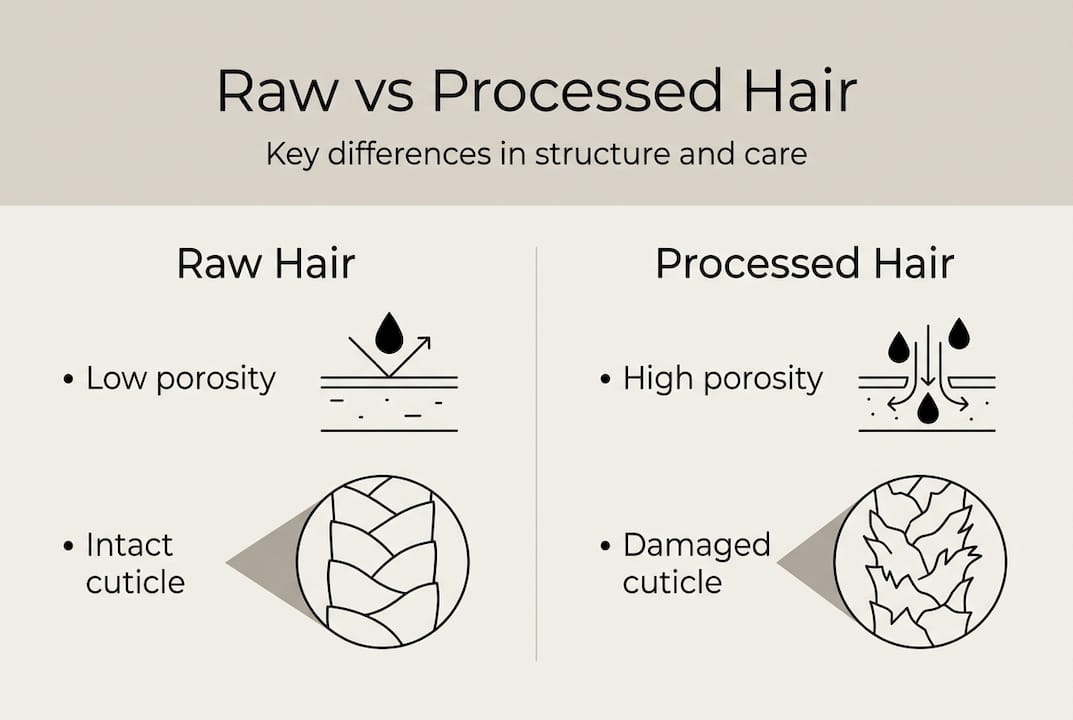
Processed hair also loses elasticity, the ability to stretch and return to its original shape. Healthy hair can stretch 30-40% before breaking. Chemically treated hair often snaps at just 10-15% extension because the protein bonds that provide elasticity have been compromised. This brittleness means processed extensions break easily during styling, installation, and removal.
Pro Tip: Test porosity by placing a single strand in water. Raw hair floats or sinks slowly because of its low porosity. Processed hair sinks immediately, confirming excessive porosity and structural damage.
The economic reality of processing also matters. To create uniform batches, manufacturers mix hair from dozens or hundreds of donors, each with different natural textures and colours. Chemical processing masks these differences temporarily, but as the treatments fade and damage accumulates, the extensions revert to a chaotic mix of textures that tangle and mat together. Premium raw hair bundles avoid this problem entirely through single donor sourcing and zero chemical intervention.
Styling versatility and durability: raw hair advantages
Raw hair’s intact structure unlocks styling possibilities that processed hair simply cannot match safely. The aligned cuticles and low porosity create a protective barrier that withstands heat up to 180°C without structural damage. You can flat iron, curl, or blow dry repeatedly without the brittleness and breakage that plague processed extensions after just a few styling sessions.
Dyeing raw hair produces professional, predictable results because the intact cuticle regulates chemical penetration. The colour developer enters the cortex gradually and evenly, creating dimensional, natural looking colour that fades gracefully over time. Processed hair, with its compromised structure, absorbs dye unevenly and unpredictably, often resulting in patchy, artificial looking colour that fades to unpleasant brassy or muddy tones.
Curly and wavy textures particularly benefit from raw hair’s natural integrity. The curl pattern in raw hair comes from the natural shape of the follicle and protein bond arrangement, not from chemical perming or steam processing. This means the curls bounce back after washing, maintain their definition through humidity, and respond beautifully to styling products designed for natural hair.
Styling methods supported by raw versus processed hair:
- Heat styling: Raw hair tolerates frequent heat without protein degradation; processed hair becomes increasingly brittle
- Chemical straightening or perming: Raw hair accepts these treatments safely once; processed hair often dissolves or breaks
- Colour lifting: Raw hair lightens predictably; processed hair produces uneven, damaged results
- Texture manipulation: Raw hair holds curls and waves naturally; processed hair loses pattern quickly
- Product absorption: Raw hair responds to leave in treatments and oils; processed hair either repels or over absorbs products
- Longevity under styling: Raw hair maintains integrity for years; processed hair degrades within months
Pro Tip: When heat styling raw hair, use a heat protectant and start at lower temperatures. The hair’s natural oils provide some protection, but external barriers enhance longevity and maintain the cuticle’s smooth alignment.
Raw hair represents an investment in styling freedom and natural beauty that pays dividends through years of wear. The ability to colour, heat style, and chemically treat your extensions without fear of damage transforms them from a temporary enhancement into a versatile, long term styling tool.
The durability advantage extends beyond styling to everyday wear. Raw hair resists tangling because the aligned cuticles glide past each other smoothly rather than catching and knotting like the rough, damaged surface of processed hair. This means less time detangling, less mechanical stress on the hair during brushing, and extensions that maintain their smooth, luxurious feel through months of wear.
Natural texture preservation matters especially for those seeking to style raw Indian hair naturally to match their own hair pattern. Processed hair’s artificial curl or wave pattern looks obviously fake and loses definition quickly. Raw hair’s authentic texture blends seamlessly, moves naturally, and maintains its character through washing, styling, and environmental exposure.
How to choose and care for raw hair extensions
Verifying authentic raw hair requires attention to several key indicators that separate genuine products from processed hair marketed deceptively. First, examine the cuticle direction by running strands between your fingers. Genuine raw hair feels smooth in one direction and slightly rough in the opposite direction, confirming intact, aligned cuticles. Processed hair feels uniformly smooth or rough because the cuticles have been damaged or removed entirely.
Single donor sourcing ensures consistency in texture, colour, and behaviour. Ask suppliers about their sourcing practices. Reputable vendors can trace their raw hair to specific donors and regions, providing transparency about origin and collection methods. Mixed donor batches, even when labelled raw, undergo processing to create uniform appearance, compromising the natural integrity you’re paying for.
Colour variation within a bundle actually indicates authenticity. Natural hair contains subtle colour shifts from root to tip as melanin production varies over time. Perfectly uniform colour across an entire bundle suggests chemical processing to standardise appearance. Look for dimensional colour with natural highlights and lowlights that reflect how hair grows.
Steps to care for raw hair extensions and maximise lifespan:
- Wash gently with sulphate free shampoo, focusing on the scalp area rather than the lengths
- Apply moisturising conditioner from mid shaft to ends, avoiding the attachment points
- Detangle carefully using a wide tooth comb, starting from the ends and working upward
- Air dry whenever possible, or use low heat settings with a heat protectant product
- Sleep with hair in a loose braid or silk bonnet to prevent tangling and friction damage
- Deep condition weekly with natural oils like argan or coconut to maintain moisture balance
- Avoid chlorine and salt water, or rinse immediately after exposure to prevent mineral buildup
- Store extensions on a hanger or mannequin head when not in use to maintain shape
Pro Tip: Apply a small amount of natural oil like argan or jojoba to the ends weekly. This mimics the scalp’s natural sebum production, which extensions don’t receive, keeping the hair soft, shiny, and protected from environmental damage.
Product selection matters significantly for raw hair maintenance. Choose styling products formulated for natural, unprocessed hair rather than those designed for chemically treated hair. Raw hair responds beautifully to simple, natural ingredients but can be overwhelmed by heavy silicones and synthetic polymers that build up on the intact cuticle surface.
Heat styling tools should include temperature control, allowing you to start low and increase only as needed. While raw hair tolerates high heat, using the minimum effective temperature preserves the natural oils and proteins that give the hair its lustre and strength. Always apply heat protectant before using hot tools, creating an additional barrier that extends the hair’s lifespan.
Preparing your natural hair properly before installation protects both your biological hair and your extensions. Clean, moisturised natural hair provides a healthy foundation that won’t transfer oils or product buildup to the extensions. Following hair extension longevity tips ensures your investment delivers maximum value through proper installation, maintenance, and removal techniques.
Establishing healthy hair wellness habits benefits both your natural hair and extensions. Proper nutrition, hydration, and scalp care create an environment where extensions thrive alongside your biological hair. Think of extension care as an extension of your overall hair health routine rather than a separate maintenance burden.
Explore premium raw hair extensions at Gaurash Beauty Supply
Finding authentic raw hair that delivers the benefits we’ve discussed requires partnering with suppliers who prioritise quality and transparency. Gaurash Beauty Supply specialises in 100% raw, virgin human hair sourced directly from single donors in India, ensuring the cuticle integrity and natural texture that make raw hair superior.
The collection includes various textures to match your natural hair pattern or desired style. Virgin Indian straight hair extensions offer sleek versatility for those seeking smooth, polished looks that accept colour and heat styling beautifully. Virgin wavy human hair bundles provide natural movement and texture that blends seamlessly with relaxed or naturally wavy hair patterns.
For those embracing their natural curl pattern, virgin Indian curly hair bundles deliver authentic bounce and definition that maintains its shape through washing and styling. Each texture category features ethically sourced, unprocessed hair that embodies the quality standards and performance characteristics detailed throughout this guide.
Frequently asked questions
What makes raw hair better than processed hair for styling?
Raw hair’s intact cuticle structure and low porosity allow it to withstand heat up to 180°C, accept dye evenly, and maintain natural texture through repeated styling. Processed hair’s damaged structure limits heat tolerance and produces unpredictable results with colour or chemical treatments.
Can processed hair be restored to look like raw hair?
No, chemical processing permanently alters hair structure by breaking protein bonds and damaging cuticles. While deep conditioning and protein treatments can temporarily improve appearance, they cannot rebuild the cuticle layer or restore the mechanical strength that raw hair possesses naturally.
How long do raw hair extensions typically last?
With proper care, raw hair extensions last two to three years while maintaining their natural texture, shine, and styling versatility. Processed hair typically degrades within six to twelve months as the compromised structure continues deteriorating through normal wear.
Is raw hair suitable for all hair textures and styles?
Yes, raw hair comes in straight, wavy, and curly textures sourced from donors with naturally diverse hair patterns. This variety allows matching to any natural hair texture, and the intact structure accepts styling to create different looks while maintaining the ability to revert to its natural pattern.
What should I look for to ensure I’m buying genuine raw hair?
Verify cuticle integrity by feeling for directional texture, confirm single donor sourcing through supplier transparency, look for natural colour variation within bundles, and test porosity by placing a strand in water. Genuine raw hair floats or sinks slowly, demonstrating the low porosity that indicates unprocessed, healthy hair structure.
Recommended
- Raw Hair Explained: Purity and Lasting Beauty – Gaurash Beauty Supply
- Why Indian Raw Hair Bundles Are the Best Choice for Premium Hair Exten – Gaurash Beauty Supply
- Raw Human Hair Explained: Authentic Beauty Benefits – Gaurash Beauty Supply
- How to Style Raw Indian Hair Naturally for Salon Results – Gaurash Beauty Supply
- How to choose natural haircare for healthier, cruelty-free hair – LUXEVA