

Understanding industry terms for wigs: a guide for informed choices
TL;DR:
- Understanding wig terminology helps prevent costly mistakes and ensures you buy the right product.
- Key terms include lace front, full lace, Remy hair, and cap construction, which dictate appearance and comfort.
- Being informed allows consumers and stylists to make style choices confidently and communicate effectively.
Buying a wig without knowing the terminology is like ordering food in a language you don’t speak. You might get something edible, but probably not what you wanted. The hair wigs/extensions market reached USD 7.8 billion in 2026, and with that scale comes an overwhelming flood of jargon: lace fronts, monofilament caps, Remy hair, density percentages. For consumers and beauty professionals alike, fluency in this language isn’t optional anymore. It’s what separates a confident, well-informed purchase from an expensive mistake. This guide breaks down every term you need to know, clearly and practically.
Table of Contents
- Why industry terms for wigs matter
- Core wig industry terms explained
- Comparing wig types and their terminology
- Practical tips for communicating with stylists and suppliers
- What most guides miss about wig terminology
- Continue your wig journey with Gaurash Beauty Supply
- Frequently asked questions
Key Takeaways
| Point | Details |
|---|---|
| Learn key terms | Understanding wig industry terms makes selection and communication much easier. |
| Check for comfort features | Features like lace front and breathable caps directly influence how a wig feels and looks. |
| Use professional language | Asking precise questions and using the right terms helps avoid costly mistakes. |
| Market is evolving | Staying updated on wig lingo keeps both consumers and pros informed as styles and tech change. |
Why industry terms for wigs matter
The wig industry is no longer a niche corner of the beauty world. It’s a thriving, fast-moving market where terminology directly shapes the quality of your purchase. When a supplier says “full lace” and you picture something different, that miscommunication costs you money and time.
Consider how specific terms carry real weight. “Lace front” refers to a sheer lace panel only at the hairline, while “full lace” means the entire cap is made of lace. These aren’t interchangeable. Neither is “closure” and “frontal.” A closure covers a small section of the scalp, typically 4x4 or 5x5 inches, while a frontal spans ear to ear. Confusing them leads to the wrong install and a look that doesn’t match your vision.
With wigs holding a 56.8% share of the hair wig and extension market, more brands and suppliers are entering the space. Not all of them use terminology consistently. Some vendors use “virgin hair” loosely, when it technically means hair that has never been chemically processed. Others label products as “raw” without meeting the true standard of single-donor, unprocessed hair.
Understanding the difference between natural vs synthetic wigs alone can save you from buying a product that can’t be heat-styled or coloured. The benefits of human hair wigs go far beyond aesthetics, including longevity, styling versatility, and a natural feel that synthetic fibres simply can’t replicate.
Here’s what poor terminology awareness can cost you:
- Ordering the wrong cap construction for your head shape
- Paying premium prices for hair that doesn’t meet “Remy” standards
- Receiving a product that doesn’t match the texture or density described
- Wasting time on returns and replacements that could have been avoided
“The right vocabulary isn’t just industry jargon. It’s your first line of defence against misleading product listings and vague supplier claims.”
For stylists, this knowledge is even more critical. Clients trust professionals to guide them. If you can’t distinguish between a 130% and 180% density wig in a consultation, you risk recommending something that won’t deliver the look your client expects.
Core wig industry terms explained
Let’s get into the vocabulary itself. These are the terms that come up repeatedly in product listings, supplier conversations, and salon consultations. Knowing them fluently puts you in control.

| Term | Definition | Why it matters |
|---|---|---|
| Lace front | Sheer lace panel at the front hairline only | Creates a natural hairline illusion |
| Full lace | Entire cap constructed from lace | Allows parting anywhere on the head |
| Monofilament | Single-layer mesh where each hair is hand-sewn | Mimics natural scalp movement |
| Density | Percentage of hair fullness (e.g., 150%, 180%) | Determines volume and weight |
| Remy | Cuticles aligned in one direction | Reduces tangling, increases longevity |
| Non-Remy | Mixed cuticle direction | More affordable but tangles faster |
| Knots | Where hair is tied to the lace | Bleached knots create a more natural look |
Here’s how to check for these features when you’re shopping:
- Read the cap construction description carefully. Look for whether the wig is lace front, full lace, or a hybrid. If it isn’t specified, ask.
- Check the density percentage. Anything between 130% and 180% is standard. Higher densities feel heavier and look fuller.
- Look for Remy or raw hair labelling. These terms have specific meanings. If a product just says “human hair” without specifying, it may be non-Remy.
- Ask about knot treatment. Bleached knots reduce the visible dots on the lace, making the hairline look more realistic.
- Confirm the lace colour. HD lace is thinner and more transparent, which suits a wider range of skin tones.
Market growth is being driven by innovations in breathable caps and advanced fibre processing, which means new terms are entering the space regularly. Staying updated on hair extension terminology keeps you ahead of trends. You’ll also find it useful to understand the broader landscape of types of hair extensions to see how wig terminology fits into the wider category.
Pro Tip: The two terms that most affect daily wear comfort are cap construction and density. Get these right and everything else becomes easier to manage.
Comparing wig types and their terminology
The same word can mean something different depending on the wig type. “Breathable” on a synthetic wig refers to the cap ventilation. On a human hair wig, it often also implies the lace material. Context matters enormously.
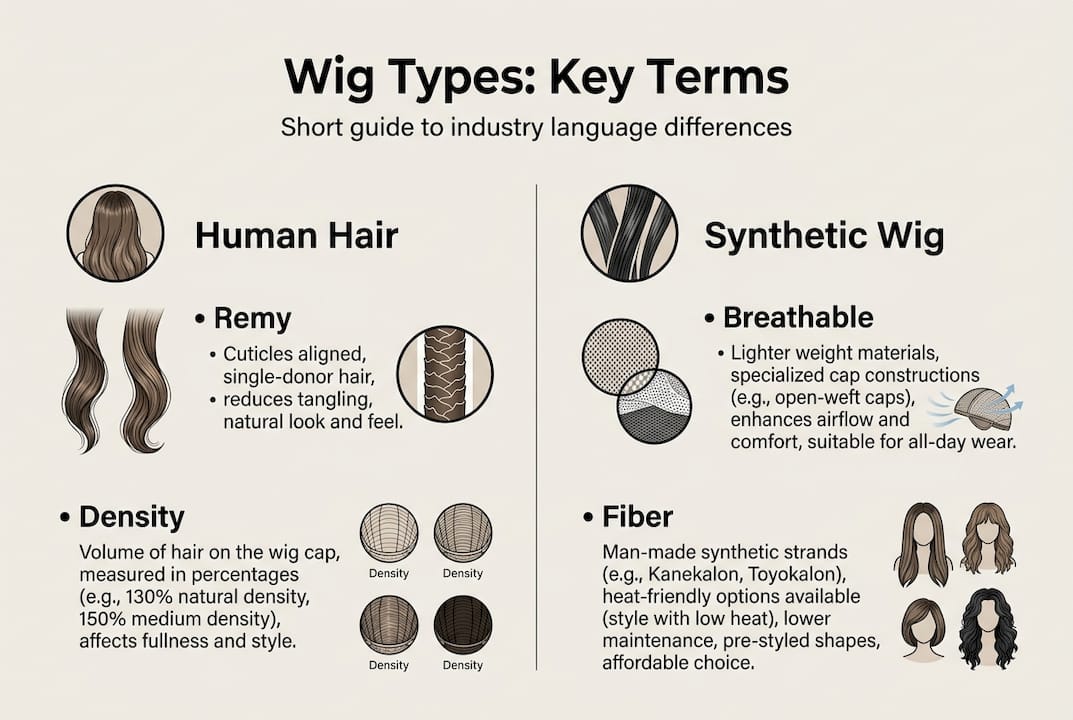
Here’s a comparison of the major wig categories and how terminology applies across them:
| Feature | Human hair wig | Synthetic wig | Lace wig | Non-lace wig |
|---|---|---|---|---|
| Styling flexibility | High (heat-friendly) | Low (heat damages most) | High (versatile parting) | Limited |
| Comfort | Natural feel, breathable | Can feel warm or stiff | Very breathable | Varies by cap |
| Price range | Higher investment | Budget-friendly | Mid to premium | Budget to mid |
| Maintenance | Requires regular care | Low maintenance | Requires careful handling | Easy upkeep |
| Longevity | 1 to 3 years with care | 3 to 6 months | Depends on hair type | Shorter lifespan |
Both medical and fashion demand are driving market growth, which explains why wig terminology has expanded to include medical-grade terms like “monofilament” and “skin top,” alongside fashion-forward terms like “HD lace” and “transparent lace.”
Understanding the differences between wigs and bundles is another foundational step. Bundles require a separate closure or frontal to create a wig, while a pre-made wig already has the cap sewn. Knowing this distinction helps you shop with purpose.
Pros and cons of each major wig category:
Human hair wigs
- Pros: Realistic look and feel, can be coloured and heat-styled, long-lasting
- Cons: Higher cost, requires more maintenance
Synthetic wigs
- Pros: Affordable, low maintenance, holds style in humidity
- Cons: Cannot be heat-styled (most), shorter lifespan, less natural feel
Lace wigs
- Pros: Natural hairline, versatile parting options, breathable
- Cons: Lace requires careful handling and adhesive application
If you’re serious about long-term wear and styling freedom, exploring real hair extensions and human hair wigs is the smarter investment.
Practical tips for communicating with stylists and suppliers
Knowing the terms is one thing. Using them confidently in a conversation is another. Whether you’re booking a wig install or placing a bulk order, the right questions protect your investment.
Here are model questions to ask before committing:
- “Is this wig full lace or lace front?” This tells you where you can part the hair and how the hairline will look.
- “What is the density, and how does it compare to a natural head of hair?” Most natural hair sits around 100 to 120%, so 150% gives moderate fullness.
- “Is the hair Remy, non-Remy, or raw?” This directly affects longevity and how the hair behaves after washing.
- “What type of lace is used, HD or regular?” HD lace is thinner and blends more seamlessly with the scalp.
- “Are the knots bleached or unbleached?” Bleached knots create a more natural-looking hairline.
- “What is the return or exchange policy if the product doesn’t match the description?” A reputable supplier will have a clear answer.
Clear language ensures consumers get the quality and style they expect, and it also signals to suppliers that you know your product. Vendors are less likely to substitute inferior materials when they know the buyer is informed.
Before placing any order, run through this checklist:
- Confirm the cap construction type in writing
- Verify the hair origin (Indian, Brazilian, etc.) and processing level
- Check density percentage matches what’s shown in product photos
- Ask for a sample or swatch if ordering in bulk
- Clarify whether the wig arrives pre-styled or requires styling
For guidance on installation and care, resources like styling human hair wigs and hair extension care tips walk you through maintaining your investment once it arrives.
Pro Tip: If a supplier can’t clearly define their own product terms, that’s a red flag. Reputable vendors welcome informed questions because they have nothing to hide.
What most guides miss about wig terminology
Most terminology guides treat industry language as a shopping checklist. Learn the words, tick the boxes, buy the wig. But there’s a deeper layer that rarely gets discussed: knowing this vocabulary is a form of protection.
The beauty industry has a long history of vague labelling and inflated claims. “Premium,” “luxury,” and “salon-quality” are marketing words. “Remy,” “raw,” and “HD lace” are technical standards. When you can tell the difference, you stop paying premium prices for marketing and start paying for actual quality.
There’s also a creative dimension. Once you understand what full lace means versus lace front, you can make intentional choices about how you want to wear and style your wig. You’re no longer limited by what a vendor recommends. You’re making decisions based on your own knowledge and preferences.
At Gaurash Hair, we’ve seen how confident, informed clients get dramatically better results, not just in purchases, but in how they express themselves through their hair. The raw human hair guide is a great starting point for understanding what genuinely unprocessed hair looks and behaves like. Mastering the language of wigs isn’t about sounding impressive. It’s about owning your choices.
Continue your wig journey with Gaurash Beauty Supply
You’ve now got the vocabulary. The next step is putting it to work with products that actually live up to the terms they use.

At Gaurash Hair, every product is built around the standards you’ve just learned. From our HD lace front blonde wig crafted from 100% raw human hair, to our curated hair closures collection featuring precisely knotted lace options, each piece is labelled with accuracy and backed by real quality. Browse the full range at Gaurash Hair and shop with the confidence that comes from knowing exactly what you’re looking for.
Frequently asked questions
What does ‘lace front’ mean in wigs?
A lace front wig features a sheer lace panel along the front hairline, allowing the hair to blend seamlessly with your scalp for a more natural appearance.
How can I tell the difference between Remy and non-Remy hair?
Remy hair has cuticles aligned in one direction, which reduces tangling and extends the lifespan of the wig, while non-Remy hair has mixed cuticle directions and tends to tangle more quickly.
Why are medical wigs often mentioned in industry reports?
Medical wigs serve clients experiencing hair loss from treatments or conditions, making them a primary factor in recent wig market expansion and a significant driver of product innovation.
What is the most important term to know before buying a wig?
Understanding cap construction, whether it’s lace front, full lace, or monofilament, is the most critical starting point because it determines both comfort and how realistic the wig will look on your scalp.
Recommended
- Differences between wigs and bundles: a 2026 guide – Gaurash Beauty Supply
- Hair extension terminology explained: a complete guide – Gaurash Beauty Supply
- Benefits of Human Hair Wigs: Confidence, Versatility, Value – Gaurash Beauty Supply
- Styling Human Hair Wigs Guide for a Natural Look – Gaurash Beauty Supply
- Navigate beauty supply stores for mature skin in 2026 – Luméra Cosmetica